Godwin Bysshe Baxter
Poor ThingsGodwin Bysshe Baxter is a research assistant whose unusual appearance and private experiments unsettle the medical world around him, while his criticism of its treatment of poor patients exposes a conflict between scientific authority and humane care. The son of the eminent surgeon Sir Colin Baxter, he inherits neither his father’s appearance nor a conventional medical career. Instead, he works at the margins of the institution: shy among colleagues, absorbed in research, and willing to intervene in cases that formal medicine neglects.
Identity and Background
Godwin is the only son of Sir Colin Baxter, the first medical man to be knighted by Queen Victoria. His father’s portrait hangs beside that of John Hunter in the examination hall, but the resemblance between father and son is slight: Sir Colin is remembered as clean-shaven and sharp-faced, while Godwin’s large face and stout, thick-limbed body give him a dwarfish appearance. Gossip about his parentage suggests that Sir Colin fathered him late in life with a domestic servant. The accounts of Godwin’s mother are contradictory and explicitly uncertain: some say she was confined in an asylum; others claim she lived in Sir Colin’s household as a silent servant. What is more firmly established is that Sir Colin gave his son his surname, a private education, and a small fortune.
Godwin’s clothes are expensive and carefully tailored, chosen to make his unusual figure appear as conventional as possible. That effort contrasts with the anxious, almost infantile cast of his face: hopeful eyes, a snub nose, a mournful mouth, and three deep, permanent creases across his brow. His coarse brown hair is neatly oiled and parted in the morning but rises into unruly tufts as the day wears on. These details make his appearance seem to resist the polish of his clothing, just as his working life resists the tidy expectations of the medical profession.
Work and Professional Marginality
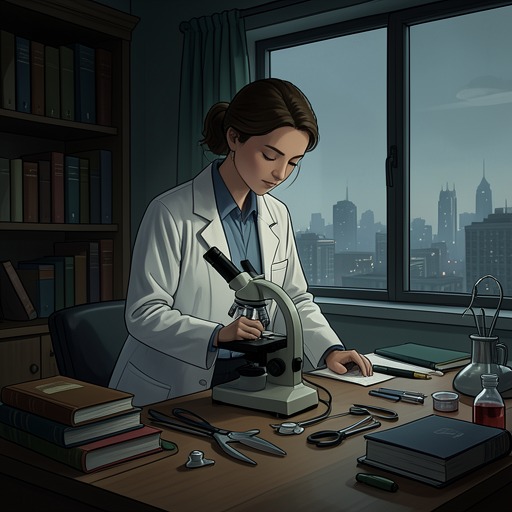
In the dissecting room, Godwin has made himself a private workspace by removing a cupboard door and setting a bench in the corner. There he prepares and examines slide sections and makes rapid notes. He sometimes leaves this solitary station to raid a tank of disinfectant containing brains, then keeps away from the people he passes. His physical size makes him conspicuous, but his shyness makes him avoid notice.
He was a brilliant student apart from his hospital work. His strange appearance and voice frightened patients and offended staff, and he did not graduate. Instead, he stayed on as a research assistant. His line of research was little known and attracted little interest; the institution tolerated his independence in part because he paid his fees regularly, caused little inconvenience, and had a famous father. Many regarded him as a scientific dabbler. Yet he also gave unpaid assistance at a clinic attached to an east-end iron foundry, where he treated burns and fractured spines with notable skill. His professional marginality therefore has two sides: he is excluded from ordinary clinical advancement, but his work reaches patients whom conventional medicine does not serve well.
Medical Principles and Class Conflict
Godwin rejects the idea that dissection alone can teach a doctor how to care for the living. In his view, concentrating on morbid anatomy can lead physicians to treat life as agitation in something essentially dead, and to regard patients’ minds and lives as irrelevant. He likens this approach to trying to learn portraiture by stripping a Rembrandt of its varnish, scraping away its paint, dissolving its ground, and separating the fibres of its canvas. The comparison insists that a living patient cannot be understood by reducing the body to its parts.
His criticism is also directed at the class structure of medical care. He describes public hospitals as places where doctors make money from the rich by practising on the poor, and argues that this explains why poor people dread and hate them while wealthy patients arrange private operations or treatment at home. He contrasts that system with Sir Colin’s practice: operating in the family’s town house in winter and country house in summer, and boiling instruments and sterilizing the operating room when hospital authorities ignored or denounced aseptic methods. Godwin recalls that surgeons concealed the deaths caused by contaminated instruments and bloodstained coats, while Ignaz Semmelweis was driven to despair and suicide by his effort to publicize the danger. Sir Colin, he says, kept his unorthodox discoveries to himself. Archibald McCandless objects that hospitals have improved since then, leaving the disagreement alive rather than resolving it: Godwin’s account indicts institutional practice, while McCandless insists on historical change.
Experiments and Ethical Restraint
Godwin’s experimental power becomes visible in the rabbits Mopsy and Flopsy. Before he put them to sleep, they were ordinary, contented animals. They woke with sharply divided black-and-white coats, opposite bodily configurations, and mixed or altered sexual characteristics. On examination, their bodies show minute ridges where one narrows and the other expands. The precision and symmetry of the changes make them seem like works of art rather than natural variations, but Godwin does not present the experiment as an uncomplicated triumph: he calls it shabby and says the rabbits are no longer interested in procreation, which they had once enjoyed. He intends to restore them the next day to exactly the condition they had before.
The experiment also prompts Godwin to describe what else his skill could accomplish. He says he could replace the diseased hearts of rich people with healthy hearts taken from the poor, making a great deal of money. He immediately rejects that possibility: he already has enough money and considers it unkind to tempt millionaires in that way. The hypothetical is darkly comic, but it also makes his ethical position concrete. His objection is not that his hands lack power; it is that medical power, joined to wealth and inequality, could turn vulnerable bodies into instruments for the privileged.
Bella Baxter and the Limits of the Account
Godwin’s connection to Bella Baxter enters the account through the recovery and examination of her body. George Geddes works for the Glasgow Humane Society, lives in a rent-free house on Glasgow Green, and is responsible for recovering people from the River Clyde and saving them when possible. When a recovered person cannot be saved and is unclaimed, the body may be transferred to dissecting rooms and laboratories; Godwin says he has arranged such transfers.
He was called to examine the body known as Bella Baxter after a quarrel with Archibald McCandless. Geddes had seen a young woman climb onto the parapet of the suspension bridge near his home and dive into the water, expelling air rather than breathing in; she did not surface alive. A reticule strap, weighted with stones, was tied to her wrist. Her fashionable clothes had empty pockets, and neat holes had been cut in the linings and lingerie where a wealthy woman might have had her name or initials sewn. Godwin found that the body was still warm, that the woman was pregnant, and that grooves remained where wedding and engagement rings had been removed. He presents these circumstances as clues for McCandless to interpret, but the account here does not explain every detail of Bella’s history or the full method by which Godwin later becomes connected with her.
Relationships and Narrative Role
Godwin’s relationship with Archibald McCandless is shaped by disclosure and disagreement. He tells McCandless about his medical principles, his father’s practices, and the circumstances surrounding Bella’s body, asking him to reason from the evidence rather than simply accept a conclusion. Later, after a quarrel, Godwin signs a letter as McCandless’s sincerely repentant friend. When McCandless hurries to Park Circus asking what is wrong with Bella, Godwin tells him that she is upstairs, not ill, and happy. He urges McCandless to remain calm and hear the whole story before trying to change her mind, while offering vegetable juice rather than port.
Godwin is thus both a source of explanation and a keeper of information: he shares striking evidence, yet sometimes places the decisive account behind his promise to tell the whole story. His mixture of reserve, technical audacity, social criticism, and personal apology makes him difficult to reduce either to a benevolent scientific genius or to a menacing experimenter. The rabbits disclose the moral cost he sees in intervention; his critique of hospitals identifies the inequalities that shape medical practice; and his account of Bella’s body makes the consequences of his research inseparable from questions of identity, consent, and care.